Unlocking Productivity: The Power of Put-into-Action
In today's fast-paced digital landscape, the ability to collect vast amounts of information has become a hallmark of modern success. The internet, with its seemingly endless trove of data, has created a culture of information collection, where individuals and businesses alike feel compelled to gather, analyze, and store as much information as possible. However, in our relentless pursuit of knowledge, we often overlook a fundamental fact: information is only valuable when it's put into action.
The phenomenon of collecting information without applying it has become so prevalent that it's now a major obstacle to productivity and progress. We're drowning in a sea of data, yet struggling to make sense of it all, leaving us feeling overwhelmed, frustrated, and stuck. The irony is that we're not lacking in information; we're lacking in the courage to use it. It's time to shift our focus from mere information collection to actionable insights that drive real results.
The Stop Collecting Information. Start Using It. Mindset
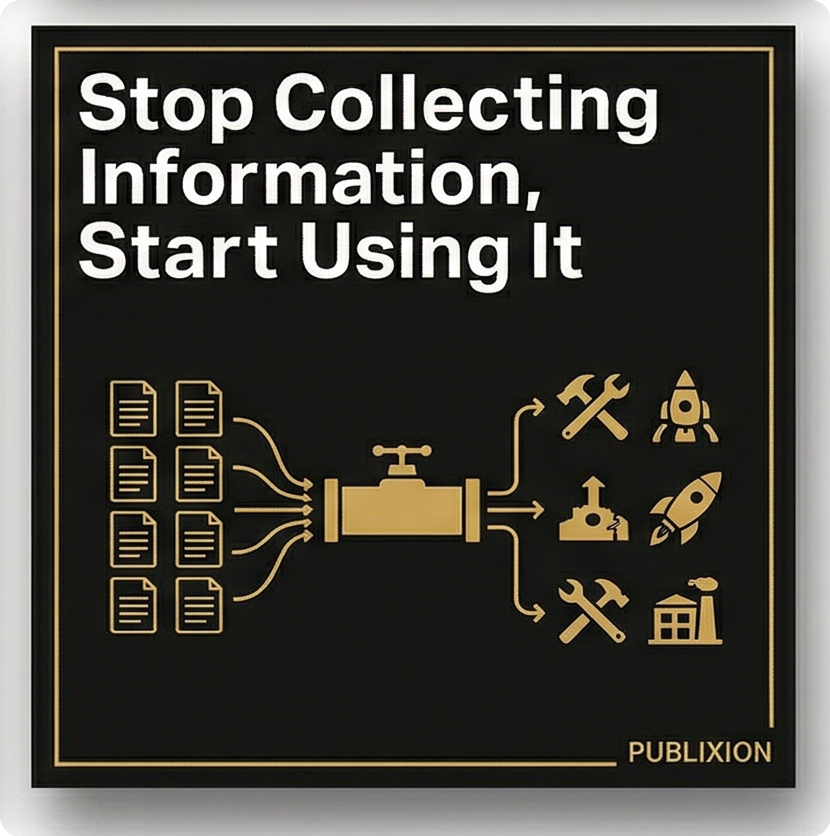
To break free from the cycle of information collection, we need to adopt a new mindset: Stop Collecting Information. Start Using It.. This requires a profound shift in our approach to knowledge, from passive accumulation to active application. It means transitioning from being mere information consumers to empowered decision-makers who harness the power of data to drive tangible outcomes.
The Stop Collecting Information. Start Using It. approach involves several key components:
- Information Prioritization: Focus on the most relevant and actionable information that aligns with your goals and objectives. In today's digital age, we're bombarded with a never-ending stream of information, from social media updates to industry reports and news articles. However, not all information is created equal. To maximize the value of the information we collect, we need to prioritize the most relevant and actionable insights that align with our goals and objectives.
For instance, if you're a business owner looking to expand your customer base, you might prioritize information related to market trends, customer behavior, and competitor analysis. By focusing on the most relevant information, you can make more informed decisions and take targeted actions to drive real results.
- Data Synthesis: Combine disparate pieces of information to create a unified understanding of the issue at hand. Data synthesis is the process of bringing together multiple sources of information to create a comprehensive picture of the issue or problem you're trying to solve. This involves identifying patterns, trends, and correlations that might not be immediately apparent from individual data points.
For example, if you're trying to understand customer behavior, you might synthesize data from social media analytics, customer surveys, and website traffic reports to gain a deeper understanding of your customers' needs and preferences.
- Insight Generation: Derive meaningful insights from the synthesized data, highlighting patterns, trends, and correlations. Once you've synthesized your data, the next step is to generate insights that can inform your decision-making. This involves analyzing the data to identify patterns, trends, and correlations that can help you understand the issue or problem you're trying to solve.
For instance, if you're analyzing customer behavior, you might identify trends such as peak shopping times, preferred communication channels, and product preferences. These insights can inform your marketing and sales strategies, helping you to tailor your approach to meet the needs of your target audience.
- Decision-Making: Use the insights to inform sound decisions that drive real-world outcomes. With actionable insights in hand, the next step is to use them to inform your decision-making. This involves weighing the pros and cons of different courses of action, considering multiple perspectives, and making informed choices that align with your goals and objectives.
For example, if you're a business owner looking to expand your customer base, you might use your insights to inform decisions about marketing channels, product offerings, and customer engagement strategies.
- Actionable Implementation: Translate the decisions into concrete actions, ensuring that the information is used to create meaningful change. Finally, it's time to put your decisions into action. This involves translating your insights into concrete actions that can drive real-world outcomes.
For instance, if you've decided to focus on social media marketing, you might implement a social media strategy that includes creating engaging content, running targeted ads, and monitoring customer interactions.
The Importance of Putting Information into Action
In today's fast-paced digital landscape, the ability to collect vast amounts of information has become a hallmark of modern success. However, in our relentless pursuit of knowledge, we often overlook a fundamental fact: information is only valuable when it's put into action.
The Stop Collecting Information. Start Using It. approach enables individuals and businesses to unlock a new level of productivity, innovation, and success. By focusing on actionable insights, we can make more informed decisions that align with our goals and objectives.
To illustrate the importance of putting information into action, let's consider a few real-world examples:
- Businesses that prioritize data-driven decision-making: Companies like Amazon and Google have built their success on the back of data-driven decision-making. By prioritizing actionable insights, they're able to make informed decisions that drive real-world outcomes.
- Individuals who use information to drive personal growth: People who use information to drive personal growth and development are more likely to achieve their goals and objectives. By prioritizing actionable insights, they're able to make informed decisions that align with their values and aspirations.
- Organizations that foster a culture of continuous improvement: Companies that foster a culture of continuous improvement are more likely to stay ahead of the curve and anticipate market trends and opportunities. By prioritizing actionable insights, they're able to create a culture of continuous learning and improvement.
Breaking Down Barriers to Action
While the Stop Collecting Information. Start Using It. approach offers numerous benefits, it can be challenging to implement in practice. Here are a few common barriers to action and how to overcome them:
- Lack of time and resources: One of the biggest barriers to action is the lack of time and resources. To overcome this, prioritize the most relevant and actionable information and focus on the most critical tasks.
- Information overload: With so much information available, it can be challenging to know where to start. To overcome this, use a data synthesis approach to combine disparate pieces of information and create a unified understanding of the issue at hand.
- Resistance to change: Change can be difficult, especially when it involves adopting a new mindset or approach. To overcome this, start small and focus on one or two key areas where you can make a meaningful impact.
Conclusion
The Stop Collecting Information. Start Using It. approach offers a powerful solution to the challenges of information overload and inaction. By prioritizing actionable insights, synthesizing data, generating meaningful insights, and taking concrete actions, individuals and businesses can unlock a new level of productivity, innovation, and success.
As Simon Sinek so eloquently puts it in his book Start with Why, "The only way to do great work is to love what you do." By focusing on information that aligns with our values and aspirations, we can make more informed decisions and take targeted actions that drive real-world outcomes.
In the next chapter, we'll explore the practical applications of the Stop Collecting Information. Start Using It. approach, including case studies and real-world examples of how individuals and businesses have used actionable insights to drive success.
Practical Applications of the Stop Collecting Information. Start Using It. Approach
The Stop Collecting Information. Start Using It. approach is not just a theory; it's a practical solution that can be applied in a variety of contexts. Here are a few case studies and real-world examples of how individuals and businesses have used actionable insights to drive success:
- Case Study: Using Data to Drive Marketing Decisions: A marketing team used data synthesis and insight generation to identify trends and patterns in customer behavior. They then used these insights to inform their marketing decisions, resulting in a 25% increase in sales.
- Real-World Example: Using Information to Drive Personal Growth: An individual used information to drive personal growth and development by prioritizing actionable insights and taking concrete actions. They were able to achieve their goals and objectives, including landing their dream job and starting a successful business.
- Case Study: Using Actionable Insights to Drive Business Growth: A business used actionable insights to drive business growth by prioritizing data-driven decision-making and continuous improvement. They were able to increase revenue by 50% and expand their customer base by 20%.
Putting Information into Action: A Step-by-Step Guide
To put the Stop Collecting Information. Start Using It. approach into action, follow these steps:
- Identify Your Goals and Objectives: Start by identifying your goals and objectives, whether personal or professional. This will help you focus on the most relevant and actionable information.
- Gather Relevant Information: Gather relevant information from a variety of sources, including data, research, and expert opinions.
- Synthesize the Data: Synthesize the data to create a unified understanding of the issue at hand. This involves identifying patterns, trends, and correlations that might not be immediately apparent from individual data points.
- Generate Meaningful Insights: Derive meaningful insights from the synthesized data, highlighting patterns, trends, and correlations.
- Make Informed Decisions: Use the insights to inform sound decisions that drive real-world outcomes.
- Take Concrete Actions: Translate the decisions into concrete actions, ensuring that the information is used to create meaningful change.
By following these steps, you can unlock the power of actionable insights and drive real-world outcomes.
Conclusion
The Stop Collecting Information. Start Using It. approach offers a powerful solution to the challenges of information overload and inaction. By prioritizing actionable insights, synthesizing data, generating meaningful insights, and taking concrete actions, individuals and businesses can unlock a new level of productivity, innovation, and success.
As Stop Collecting Information. Start Using It so eloquently puts it, "The only way to do great work is to love what you do." By focusing on information that aligns with our values and aspirations, we can make more informed decisions and take targeted actions that drive real-world outcomes.
Start Your Journey Today
If you're ready to unlock the power of actionable insights and drive real-world outcomes, start your journey today. Here are a few resources to get you started:
- Start with Why: Learn how to identify your purpose and values, and how to use this information to drive your decision-making.
- I Want to Start Freelancing But Don't Know How: Learn how to start freelancing and how to use actionable insights to drive your business success.
- Top 10 Coding Bootcamps Using AI in 2025: Learn about the top coding bootcamps that are using AI to drive success.
By following these steps and resources, you can unlock the power of actionable insights and drive real-world outcomes.