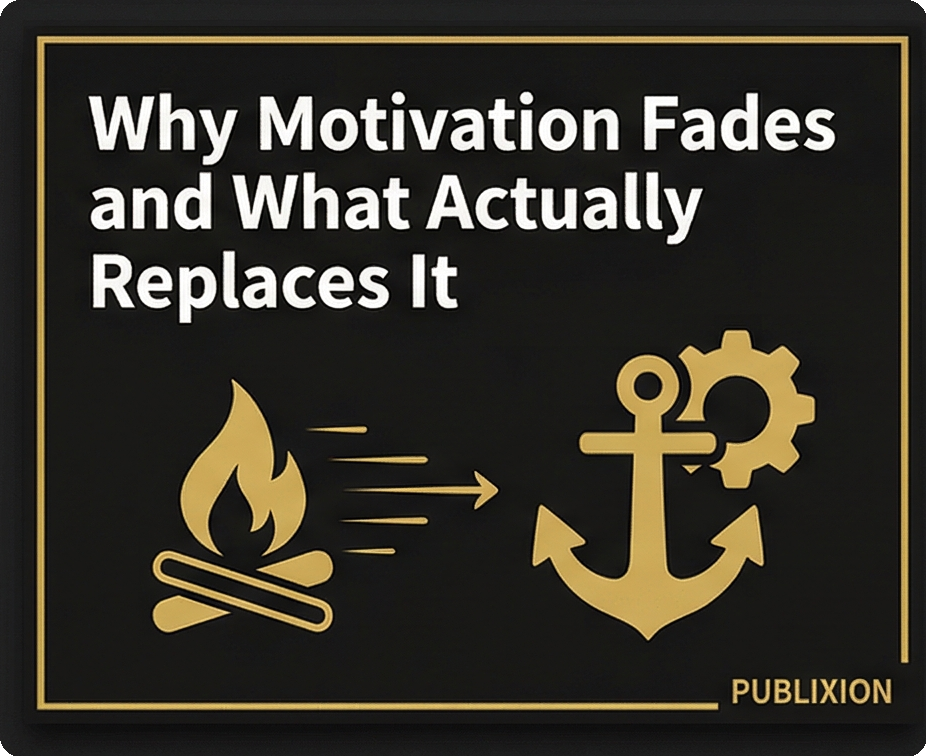
The Motivation Paradox: A Technical Guide to Sustainable Action Architecture
I. Introduction: The February Phenomenon
By mid-February, the gym is empty again. The writing app gathers digital dust. The language-learning streak dies quietly, buried under a notification badge you’ve learned to ignore. We blame ourselves—I just lost motivation—as if this were a personal failing, a lack of character or desire. But the truth is more mechanical and less moral: motivation is designed to fade. It is not a fuel source you’ve failed to conserve; it is evolutionary starter fluid, chemically engineered to burn hot and brief, propelling you away from predators or toward novel opportunities before your neocortex can overthink the expenditure of calories. Expecting motivation to power a months-long project is like expecting a match to heat a house. It was never going to last. The question isn’t why you keep losing motivation; it’s why you keep expecting it to stay.
Neuroscience confirms what February’s abandoned resolutions suggest. Motivation operates primarily through dopaminergic prediction errors—your brain rewards you for novelty and anticipation, not for the grinding, repetitive reality of execution. That initial spark you felt when you bought the running shoes or outlined the novel? It was your brain’s response to a new variable, a potential reward on the horizon. But brains are homeostatic machines. They regulate. The fourth run feels less rewarding than the first; the fiftieth page lacks the dopaminergic sparkle of the blank document. This isn’t laziness. It is neurochemistry doing exactly what it evolved to do: conserve energy, avoid predictable expenditure, and return you to baseline affect. When we rely on motivation, we are essentially trying to build a house using only the weather—hoping the sun stays shining because we really need to pour the foundation.
The modern productivity industrial complex sells us the lie that we can hack this, that the right vision board or morning routine will sustain that initial high. This is dangerous. It creates a dependency on emotional weather, teaching us that action requires feeling like it. But here is the uncomfortable reality that separates those who finish from those who fade: sustainable action happens in emotional flatness. It happens when the inspiration is gone, when the goal feels distant and the process feels mechanical. The replacement for motivation is not "more motivation" or "stronger discipline" in the punitive sense. It is infrastructure. It is the shift from goal-based chasing to system-based being—from "I want to write a book" (feeling-dependent) to "I write 500 words at 7 AM regardless of quality" (identity-based). It is the recognition that discipline is not willpower but reduced friction; that commitment devices matter more than morning affirmations; that your environment must carry the load when your heart isn’t in it.
This guide is an autopsy of the motivational myth and a blueprint for what replaces it. We will dissect the neurochemical half-life of enthusiasm, exposing exactly why your brain betrays your best intentions. Then we will build the alternative: an architecture of action that functions in dopaminergic drought, using identity shifts, implementation intentions, and environmental design to create what motivation never could—inevitability. The match has already gone out. It’s time to install the furnace.
II. The Neurochemistry of Disappointment
To understand why your January ambitions become February regrets, you must understand prediction errors. Dopamine does not reward you for pleasure; it rewards you for anticipation—specifically, for the gap between what you expect and what you get. When you first lace up those running shoes or open that blank document, your brain floods with dopamine not because the act itself is enjoyable, but because it represents novelty, a potential future reward that your brain has not yet mapped. You are, chemically speaking, high on possibility.
But the brain is a Bayesian prediction machine. It learns. By the fourth run, the fifth writing session, the tenth vocabulary drill, the activity is no longer novel. The prediction error shrinks to zero, and dopamine collapses back to baseline. This is the hedonic treadmill of goal pursuit: you are not running toward a dopaminergic paradise; you are running to stay at neutral. Worse, the brain exhibits emotional homeostasis—a regulatory tendency to return to your affective set point. Just as a thermostat maintains temperature, your neural architecture maintains your baseline mood. The initial "inspired" state was always a temporary deviation, not a new normal. Your brain interprets sustained elevation as a threat to energy conservation and systematically dampens your enthusiasm.
This creates the affect-behavior gap, the dangerous chasm between feeling like doing something and actually doing it. We have been conditioned by motivational culture to treat emotion as a prerequisite for action—the "when I feel motivated, I will act" fallacy. But neurochemically, waiting for motivation is like waiting for a specific weather pattern before leaving your house. You are outsourcing your agency to a neurotransmitter system designed to be fickle. The correlation between affect and behavior is, in longitudinal studies, barely above chance. Action does not require enthusiasm; it requires only the removal of friction and the tolerance of emotional flatness.
In our current digital ecosystem, this neurochemical vulnerability is exploited by design. The same dopaminergic mechanisms that fade during long-term goal pursuit are hijacked by infinite scroll feeds and notification architectures. Understanding these mechanisms is crucial for reclaiming autonomy. Resources like Mindful Digital Life: Balancing Technology and Well-being: Reclaim Your Focus and Rewire Your Habits provide essential frameworks for dismantling the attention economy's grip on your neurochemistry, allowing you to redirect those finite dopaminergic resources toward meaningful long-term systems rather than ephemeral digital rewards.
III. The Architecture of Fading
Even if you could sustain dopaminergic intensity, hyperbolic discounting would still doom the motivated approach. This mathematical certainty describes how humans systematically devalue future rewards as they become temporally distant, while simultaneously overvaluing immediate comfort. Your brain literally calculates your future self as a stranger, unworthy of present sacrifice. When motivation is high, the discounted future reward still seems valuable enough to overcome immediate discomfort. But as the novelty fades, the math shifts. The present pain of the gym looms larger than the future benefit of fitness. Without infrastructure, you are asking your present self to make continuous sacrifices for a future self it neurologically does not recognize as "me."
Compounding this is the identity-behavior mismatch. Motivation often asks us to perform actions inconsistent with our self-concept. When you declare "I want to write a book" but your internal narrative says "I am not a writer," every writing session creates cognitive dissonance. The brain experiences this dissonance as physical threat, activating the same neural pathways as physical pain. Motivation cannot overcome identity; it can only temporarily mask the conflict. Until the self-concept shifts, the behavior will be rejected like a transplanted organ.
Finally, decision fatigue erodes the motivational strategy from another angle. Relying on daily enthusiasm requires constant emotional negotiation—waking up each morning and re-convincing yourself to act. This negotiation consumes glucose and executive function, depleting the very willpower you believe you need. Every decision to "get motivated" is a tax on a finite resource. By Wednesday, your cognitive accounts are overdrawn, and you skip the gym not because you lack desire, but because you lack the mental currency to make the decision again.
It is worth noting that these neurological and psychological constraints do not operate in isolation from your physiological infrastructure. The gut-brain axis significantly influences neurotransmitter production and emotional regulation. Disruptions in this biological foundation can accelerate decision fatigue and emotional volatility. For those seeking to optimize their biological substrate for sustained performance, The Gut Health Revolution: Harnessing Prebiotics and Probiotics offers critical insights into maintaining the physiological stability required for long-term system adherence.
IV. The Myth of "Finding" Motivation
We remember motivation incorrectly. The peak-end rule, identified by Kahneman, dictates that we recall experiences not by their average intensity, but by their peak moment and their ending. When you look back on that "productive weekend" or that "inspired writing session," you remember the euphoric peak—the flow state, the runner's high—not the three hours of grinding mediocrity that preceded it. This creates a distorted template for future action. You expect to replicate the peak, but the peak was an outlier, a statistical anomaly. When reality delivers the inevitable regression to the mean, you interpret the normal, flat experience of work as failure.
This distortion fuels the inspiration porn economy—the multi-billion-dollar industry of motivational quotes, morning routine videos, and "hustle culture" content. These artifacts sell the peak as sustainable, creating a dependency on affective highs. They suggest that if you just visualize hard enough, journal correctly, or consume the right content, you can maintain the dopaminergic spark indefinitely. This is pharmacologically impossible. Worse, it trains you to abandon ship the moment the feeling fades, teaching you that "not feeling it" is a valid signal to stop, rather than the background noise of meaningful work.
The research is unambiguous: the sustainability threshold is breached when habits depend on affective states. Studies of habit formation indicate that when motivation is the primary driver, failure rates approach 94% within six months. Conversely, when systems and identity anchor the behavior, failure rates invert. Motivation is not a renewable resource to be "found" through better Instagram algorithms; it is a finite neurochemical event that, if depended upon, guarantees cyclical failure.
V. What Actually Replaces It: The Infrastructure of Action
The alternative is not "more discipline" in the Victorian sense of white-knuckled suffering, but systems over goals. As James Clear articulates, goals are outcomes you want; systems are processes that lead to outcomes. "I want to write a book" is a goal dependent on future motivation; "I write 500 words every morning at 7 AM" is a system that functions in motivational drought. The shift is from outcome-based chasing to process-based identity. You stop trying to get something and start operating as someone who is something.
This requires redefining discipline as reduced friction, not increased suffering. Discipline is not the ability to resist temptation through sheer will; it is the intelligence to remove temptation from the environment. It is the Ulysses contract—